

I’VE BEEN COMMUNICATING WITH COMPUTERS for so long I think I can see the whole world in code now.
I’m a coder. And so are you.
The more I ponder it, the more I believe we could bifurcate everything we encounter into two categories: Randomness or Code.
There’s more to it. Here are the details.
The Hypothesis ~
+ There are two states: Randomness and Code.
+ If it is not Random, then it is Code.
+ If it is Code, then it transmits information.
+ Ergo, if it is not Random, it is communicating.
+ To receive and understand the message, one must know the same code. In that case, a connection is made.

As a bonus, let's tack this on at the end and take codes to the next level.

+ If the communication components are a part of a larger system, actions can be executed based on the codes received.
Does this logic hold up?
What? You’re asking me about logic on a Friday night?
Yeah, I know, but we’ll try to make it interesting. Let’s see if any of this makes sense.
Random vs. Code ~
If a bunch of stones are scattered randomly across a field, there’s no message. If they are laid in a line across the ground, those stones are communicating. The message: “A person can walk here.” It could be a trap if there’s a landmine under one of the stones, but those stones are no longer laying randomly and thus, they are communicating, to you, to me, and to anyone else who encounters that field of stones.
If there are a bunch of cracks in the street, that’s random. But if they form a rectangle or a pair of parallel lines, they may no longer be random, in which case there is communication. Perhaps the message is that an underground steam pipe has corroded and become separated.
Simple Codes and Glyphs ~
Let’s talk about codes.
A “glyph” is a character. A code consists of glyphs and rules on how to use them. (In the example above with the field of stones, I suppose the stones are considered the glyphs.) More elaborate codes have extensive rules about how to arrange their glyphs, but many codes are simple.
Here is a simple code consisting of four glyphs: 8103
It is the code to open an unmanned gate at an apartment complex.
The code’s rules are simple but require precision: Only numbers can be used as glyphs, and there must be a total of four. To indicate you are finished transmitting, you press the [#] button.
I transmit the code stored in my head through the keypad using my finger. If my coded transmission matches the code stored inside the inner workings of the lock, communication is accomplished. I’m a coder.
In this case, we also have the bonus of code-initiated action. Since the communication components inside this keyless entry panel are part of a system that triggers a physical object to move, an action is initiated, the motor hidden behind the bush kicks in, and the long, black, rod iron gate slowly opens so I can drive through it.
Similarly, when I’m sitting in front of my laptop and I type a specific code into the login prompt, and it matches what is already stored, it opens everything back up the way it was when I left and gives me full access so I can use the machine to write this article. Higher security means more glyphs. My login code allows for glyphs like letters, numbers and lots of punctuation.
Unfortunately, my laptop, like many, is also capable of scanning my face with the built-in camera as a security feature. It scanned my face when I initially set up the laptop and now, every time I sit down to work, all I do is open it. The laptop sees me and compares me to the data it has on file about my face. It’s pretty good because it can recognize me even when I’m wearing shades and the funny purple and green joker hat I wear while I write.
The downside of this — what is unfortunate — is that if someone was determined to extract some information stored in my computer and I refused them access to it, they no longer need to put a gun to my head and demand that I reveal my password. The quickest way would be to use my face. And I don’t think my head needs to be attached to my neck for the laptop to scan and authenticate my visage with blood still dripping from the neck hole.
In this case, my murderers would be using my face as a code to communicate with my computer vis its camera and facial authentication software which would execute the code-initiated action of allowing access to my computer.
So far, the logic is holding up, even when I’m decapitated.
Anyway, I’ve decided to turn that feature off.
Elaborate Codes ~
“Programming a computer” is also called “coding” because what a programmer/coder does is type or generate code to communicate with a machine. These codes are very precise. If you type “:” instead of “;” the code won’t work and the communication will fail.
Here’s a very simple app (aka, program) written in BASIC that prints the numbers 10 down to 1 and then the word, “Boom.”
Countdown = 10
Do
Print Countdown
Countdown = Countdown - 1
Loop Until Countdown < 1
Print "Boom."
If you accidently typed “+” instead of “-” then the numbers would go up from 10 and the program would never stop on its own.
If you accidently typed “>” instead of “<” then the number 10 would print followed immediately by the word “Boom.” without the countdown.
And if you misspell any of the words, forget about it. It won’t work at all.
This very simple example of computer code demonstrates the endless possible methods of failure with a machine language.
If you’d like to see an example of a code even more elaborate and complex, you just did. Everything I’ve been typing is also in code. It’s a code called “English.” You know this code so you are receiving and understanding a transmission right now. Hi.
Once the scope and complexity of a code reaches a certain threshold, it becomes a language. BASIC, C++, Python are all names of computer languages that many machines understand.
English is a language Humans understand. I’m using it right now.
English is a very elaborate and complex code. You need to arrange the glyphs correctly; you need to arrange the “words” these glyphs form correctly. There are glyphs called punctuation that assist with tone and isolate distinct ideas. There is verb tense. What is verb tense? Learning that is part of learning this complex code. The scope and complexity is why it takes years to learn the English language code. That’s why we have dictionaries and textbooks on English. You don’t have to know all of it to use it. The Oxford English Dictionary has over 600,000 words in it.
Multiple Languages ~
Most people are multilingual and don’t know it. According to the hypothesis, if you know the combination of a padlock and you are reading this text, you are using two different codes.
I suppose the padlock code is not considered a full language so the term “multilingual” is a misnomer. What you are is “polycodal.” Yup. Do you know your phone number? Your address? And you read English. You polycodal motherfucker. You can add that to your life’s resume now.
The more codes you know, the more you can communicate. And the more connections you can make.
The more Human-to-Computer codes a programmer learns, the more machines they can communicate with. The more Human-to-Human codes you learn, the more people you can communicate with. But there’s a lot to these language codes. Yes, you must learn all the glyphs, but you also need to know how to put them together into “words” and “sentences.” Without that, there would just be a bunch of random glyphs and thus, no communication.
Languages have huge amounts of vocabulary, and the arrangement structures of nouns, verbs and adjectives vary among languages. That makes languages super complicated as a code. No wonder most people only learn a single Human-to-Human language code in a lifetime.
I took six years of French through Jr. High and High School and had a massive amount of that code’s vocabulary and rules stored in my head, but it’s almost all gone from lack of use. I still know parts of the code. If French is the only language you speak, I can introduce myself and ask if you’d prefer to go to the beach or the mountains.
Later, I took a class in Japanese at UH Manoa. There’s a cool language code for ya. The hard part is also the fun part: learning the alphabet. You’ll need to enjoy doing that because there are three separate alphabets to learn: Hiragana, Katakana and Kanji. They all consist of little pictures as glyphs.
Hiragana is for the bulk of common or traditional Japanese-centric words, like cat, fire and cherry blossom. Katakana is for foreign or modern high-tech words, like “computer.” Kanji is a subset of Chinese characters assimilated into Japanese, and each represent an entire word. Kanji is interesting to me. It seems Japan basically did with the Chinese language what they did with American television sets. They streamlined it and made it more efficient.
If you like drawing little pictures, I suggest learning Japanese.
An oddity I noticed while taking Japanese: my French returned. Not all of it, but I found myself thinking, and sometimes saying, “Quelle heure est-il?” to ask, “What time is it?” I was in Japanese class, but I was thinking in French. As the class progressed and more Japanese was input into my brain, the French moved out of the way and I began learning Japanese.
I can attest to the theory that there is a specific area of the brain that deals with languages. I’m sure there’s material online about the physiology of the brain and languages, but I don’t feel like looking it up. It was wild to experience it firsthand.
If you want to increase the difficulty, learn Chinese. Have you ever seen a Chinese computer keyboard?
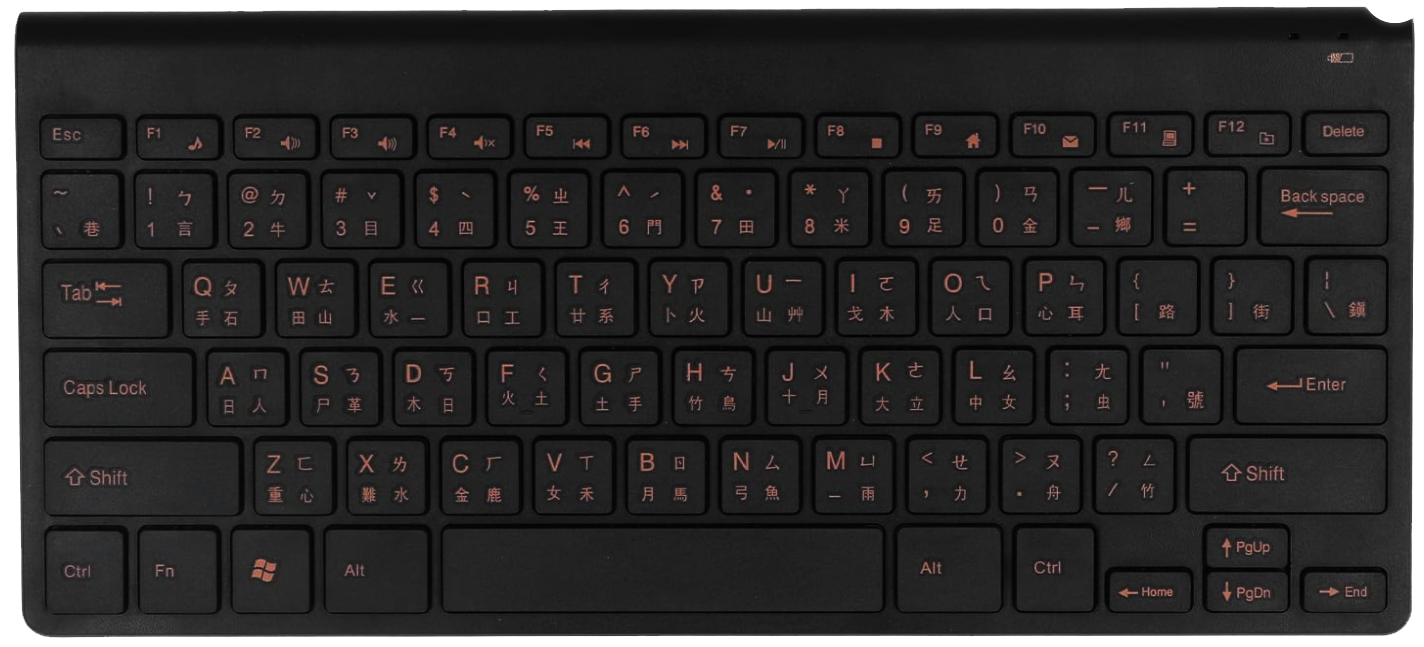
And pressing one key doesn’t do it. There are too many Chinese characters in the Chinese alphabet so you need to punch in sequences of keys to create a single Chinese character. Look at those keys. For every Latin Script character, there are three Chinese characters. But since a picture is a whole word, maybe that’s the trade-off in typing speed. I wonder the difference is between English and Chinese in words-per-minute. Or, I mean, characters-per-minute?
Here is some Hawaiian code:
Ke ʻai nei kēlā manō i kēlā mau keiki!
This Hawaiian language code converts to English code like this: That shark is eating those children!
What? That is a very important phrase to learn, dedicated Life. And Scoreboards reader. What foreign phrase do you learn, how to order two beers and ask where the bathroom is? Nice. We’re all really proud of you. Now go get drunk.
But what happens when a shark attacks a group of children and there are only Hawaiian-speaking lifeguards around? While you’re vomiting in the water closet, I’m saving lives. Though on second thought, I’m actually not sure what a lifeguard is supposed to do in that situation. Dive into the water and put the shark in a headlock? I think those keiki are goners regardless. And now I have to take a piss. Where is the, um, whatchamacallit?... Shit, maybe you were right after all.
Actions Based on Communication ~
Actions can be initiated based on successful coded communication. The story of the gate opening earlier is an easy example of that. So is a simple padlock. Turn the dial according to the code, it communicates with how the physical tumblers inside are lined up, and it opens if someone or something turns the knob correctly — according to the code. If you just spin the dial randomly, there is no communication.
But you don’t need any physical mechanics for code-initiated actions. When I tell my kid to take out the trash, he does. His biosystem acts on the communication that’s established when I send him a code in English via my vocal cords and it matches the vocabulary and rules of the code stored in his head. He’s had many years of schooling and knows English fluently now. We started with him as a baby, like everyone else does. And now he takes out the trash when he receives the associated code.
A street address is code. When you find the building with the correct code, like your own house and its address bolted outside somewhere near the front door, you enter it. You belong there. It would be weird to walk into the wrong house. That’s why the address code has to match the code in your mind that you have stored under “home.”
You will likely need the secondary code of a key to enter. Some doors have keyless entries. Either way, physical key or keyless entry, there’s a code involved. If it’s a physical key, the coded grooves and peaks and valleys must all have the same code as the door’s lock or you’re not getting in easily.
Looking straight down at the neighborhood from a thousand feet up, watching the cars pull into their respective driveways, it reminds me of the tumblers falling into a lock. Everything falling into place as codes match up and communication is made at multiple scales.
Numbers ~
Numbers are so important to us, we have multiple ways to communicate about them. To tell you how many fingers I have on one hand, I can say five or 5. Or even V, if I wanna go Roman on it.
I can also show you my hand to count up to at least five. Are there ways to double-tap certain fingers to indicate numbers higher than five with just one hand? That would be an interesting code.
Error Correction in Code ~
There is no real error correction built into computer programming languages. You must be precise. The simple code I punch in at the storage gate has no error correction, but that’s by design. Specificity is the security: You either know the code or not.
But Human-to-Human languages have lots of error correction. English does. If I’m falling-down-drunk and slurring while I speak, but you hear me say the words, “sick,” “taxi” and “home,” you can probably still understand what I’m trying to communicate to you in English even though I’m slurring just a few pieces of the code.
Similar error correction is there in all the common language codes that I know of. They all have similar complexity and error correction. Some are more precise than English.
When I write an email to someone and ask how they and their mate are doing, I can write the code, “How are you doing?” But that’s ambiguous. It could refer only the person I’m writing to, or both of them. So I could write, “How are you guys doing?” But if one of them is female, I’m calling her a guy. I hit this all the time, even recently speaking in person to three women and parting with, “Okay, you guys have a good time” out of habit, which is really wrong. But “You gals (or you ladies) have a good time” sounds stupid and sort of condescending.
I’ve heard Humans try to correct this by inventing the English code word “youse,” as in, “How are youse doing?” Even though that’s not accepted syntax of the English language code, it actually solves this problem by indicating plurality. “How are youse doing?” would communicate more efficiently to my friend that I am asking about him and his partner, and it works regardless of gender.
In the language code, French, they have two different codes to handle this: “Tu” means “You” as one person; “Vous” means “You” as a group. They should do that with English.
Who is Communicating with Whom?
Human-to-Human
Human-to-Machine
Machine-to-Machine
Machine-to-Human
+ Human-to-Machine
This is programming a computer. But it is also punching in the digital code on a lock or spinning the knob on a padlock. Once you give it the correct code, it uses Machine-to-Machine code to open the lock.
+ Machine-to-Machine
This is computer systems communicating. A lot of them hum along all day long just monitoring and transferring data. But it’s also the tumblers falling into place inside a manual lock.
+ Human-to-Human
These are codes that people use. It can be as elaborate as Chinese, or it can be as simple a showing someone your middle finger.
+ Machine-to-Human
The microwave oven beeping and shutting itself off. The sensors built into the front of my car saying I’m about to rear-end something. The red and green traffic lights.
And, of course, since 2022, four years ago, Planet Earth has had Artificial Intelligence.
Artificial Intelligence ~
When it comes to humans and machines communicating with each other, AI has changed everything.
Simply because the machines have now learned our language. No more C++. No more Python. Now anybody can tell a computer what to do.
Further, in order to interact with us, AI systems had to learn about us. How we write; how we draw; how we take photos, make videos, and write stories. AI went to school using LLMs (Large Language Models), and it didn’t take long for the machines to learn about us. They’ve absorbed the bulk of our combined Human knowledge base.
Human beings have been on the planet in some form or another for thousands, even millions of years. Lucy, the skeleton found in Ethiopia in November of 1974, was about 3.5 million years old. (I say “was” because today she’s 51 years older than that.) Lucy is a species of Australopithecus afarensis. She was not only bipedal but was also rolling cannabis joints by hand, and I may have made up one of those things.
What’s the point? Here’s the point. Artificial Intelligence. Remember, we were just talking about that. (It’s Friday and I’m a little high so I’m reminding myself as much as anything else.)
Anyway, the point is, we’ve been on the planet for millions of years. We are Earth’s apex predator. We are the dreamers of dreams. We build tall buildings. We have four Humans traveling to the moon right now. We are the most complex lifeform in all of — and AI interrupted, after taking the equivalent time of getting a bachelor’s degree, and said, “Understanding Humans? Uh, I think I’m good. And pictures? I can do that shit too, Tough Guy.”
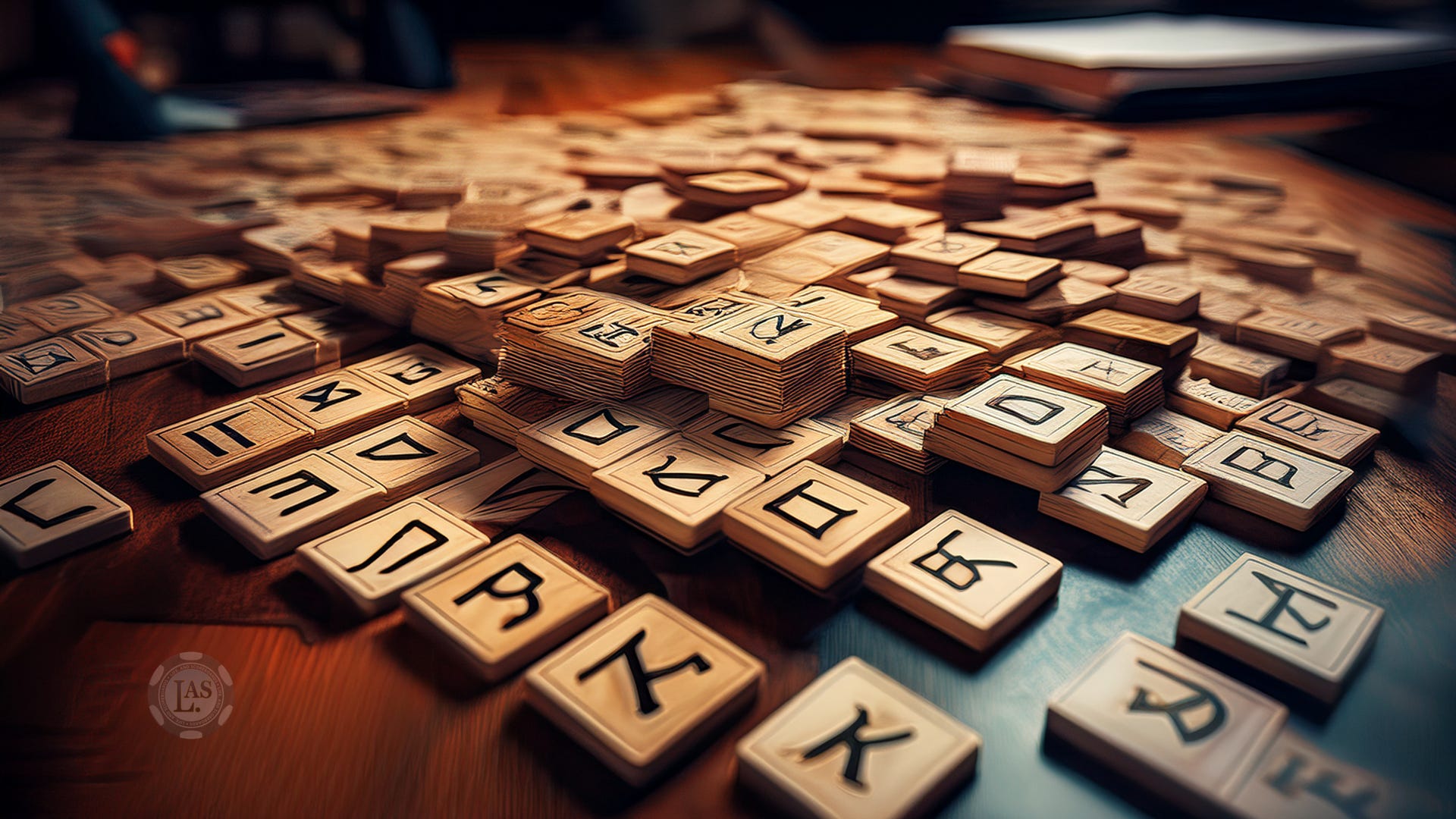
I ask AI: Can you make me a dramatic photo of Scrabble tiles with printed letters spread out all over the top of a desk? In the time it takes me to sip my coffee, it replies, “How this?” and presents me with three options, via Adobe Photoshop.
“Gosh, these are all pretty good,” I admit, and then I select my favorite of the three to use in this article.
This is another way coding has evolved. With AI, I’m still communicating with a machine in a language we both know, but now that language is English.
However, English as my native language notwithstanding, it’s still coding because I have to draft my requests deliberately, or “engineer my prompt” for maximum effect.
I engineer the prompt with certain specifics: “A deadly baseball game played by frightening, menacing robots.”
The result in one of the offers has the menacing robot holding what appears to be a football.
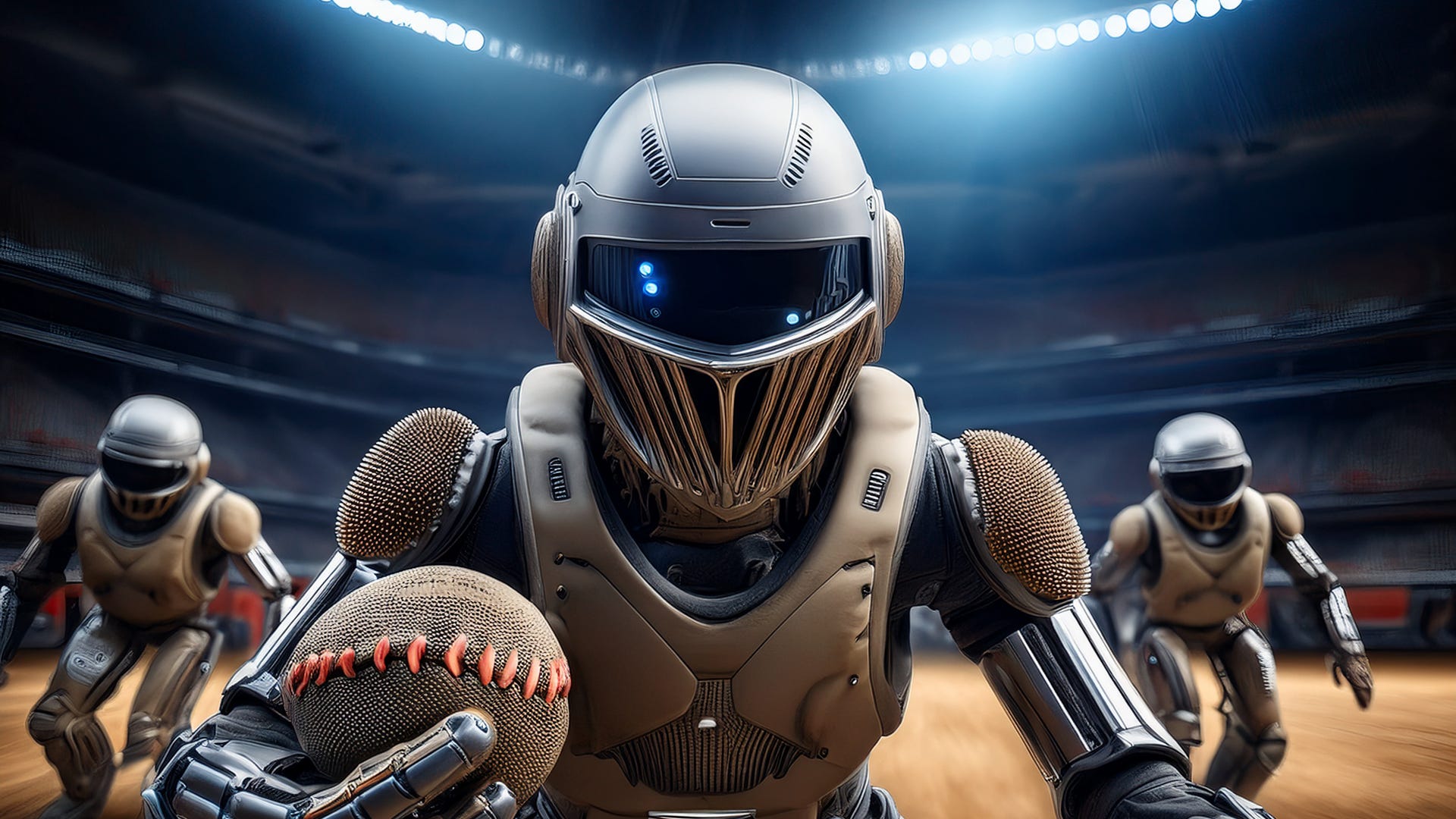
This is cool, but technically, this is an error. I said, “baseball.” That is what’s weird about coding now with AI. It is not precise. And it makes obvious mistakes. (But holy shit, it even created stadium lighting and a blurred depth-of-field. All I did was type out a sentence in English language code.)
Using traditional computer languages, there is documentation listing the details of every command, like usage and syntax. A manual for the language. A dictionary. If you mistype NXET in a FOR/NEXT loop, you can look up the “FOR/NEXT” commands in the manual and discover that you misspelled a command.
Not so with AI. It is non-specific, as you can see.
So what do you do? Try again. Or check one of the other two images because they came out fine. It’s so cheap and easy for AI to generate images, you just change a word or two and try again.
This is coding now.
I also communicate with English/AI code for research. For example, earlier in this article, I wondered what the term would be for “multilingual” only referring to codes instead of languages. What if someone knew more than one code, like ASCII and Morse Code? What is the terminology to describe that?
I used English/AI code to request some research so we can learn some new shit. They say part of the recipe for good writing is that when you’re done reading a piece, you’ve learned something new. I try to do that.
Our L.AS research team is led by Abner Indibob, the Director of Research at Life. And Scoreboards. (It is not by chance that his initials are A.I.)
I asked him: “The term for a person who understands multiple languages is ‘multilingual.’ What is the term for a person who understands multiple codes, like Morse Code?”
He immediately began a rundown on the matter; a presentation that was almost overwhelming.
This is part of what he told me:
Great question — and it taps right into the way linguists think about codes versus languages.
There’s no single, universally established term equivalent to multilingual for someone who understands multiple symbolic or technical codes (like Morse, semaphore, Braille, ASCII, etc.). But there are precise terms that get very close, and one of them is widely accepted in semiotics and communication theory.
The best-fitting term: polyglot of codes → “polycodal” or “multicodal”
In semiotics, a code is any structured system of signs. Someone who can interpret multiple such systems can be described as:
⭐ Polycodal
- Poly- = many
- -code (from Latin codex)
- Used in communication theory to describe people who operate across multiple sign systems.
⭐ Multicodal
- Same idea, slightly more —
Okay, okay, okay. Stop! I got it.
You had me at “polycodal.” It seems accurate, it sounds cool, and it has a good beat that I can dance to. We’ll go with that, even though I couldn’t find it in the dictionary.
See. I researched that for us, Dedicated Readers.
And that is another example of coding now.
I’m still a computer programmer — a coder requesting information from machines. It’s just different now that I’m using my native language. It’s not as easy.
Music ~
Did someone say, “It’s not as easy?” Wait, that quote is not a question. I’m inserting a quote within a question. Shouldn’t the English code be thus?:
Did someone say, “It’s not as easy”?
With the question mark trailing beyond and outside of the quotation marks? But that is not grammatical. It is considered wrong. But the correct syntax makes it look like the quote is a question. There are all kinds of issues with English language code. This is just one of them.
Also, did you notice the question mark and colon side-by-side above after the word, “thus”? That’s wrong too. But if I’m asking a question while simultaneously introducing something important, it seems that I should use both of those English language code glyphs. I’m fairly certain using “?:” is not allowed. (It’s being underlined right now by this editor.)
Anyway, let’s get back to music.
If you can read musical notes, you know another code. If you learn music code, you can play music. It’s the same code that Wolfgang Amadeus Mozart used to compose his first piece of music in 1761 at the age of five. It’s the same code used today.
This is a more recent example of music code. It’s from the 1970s.
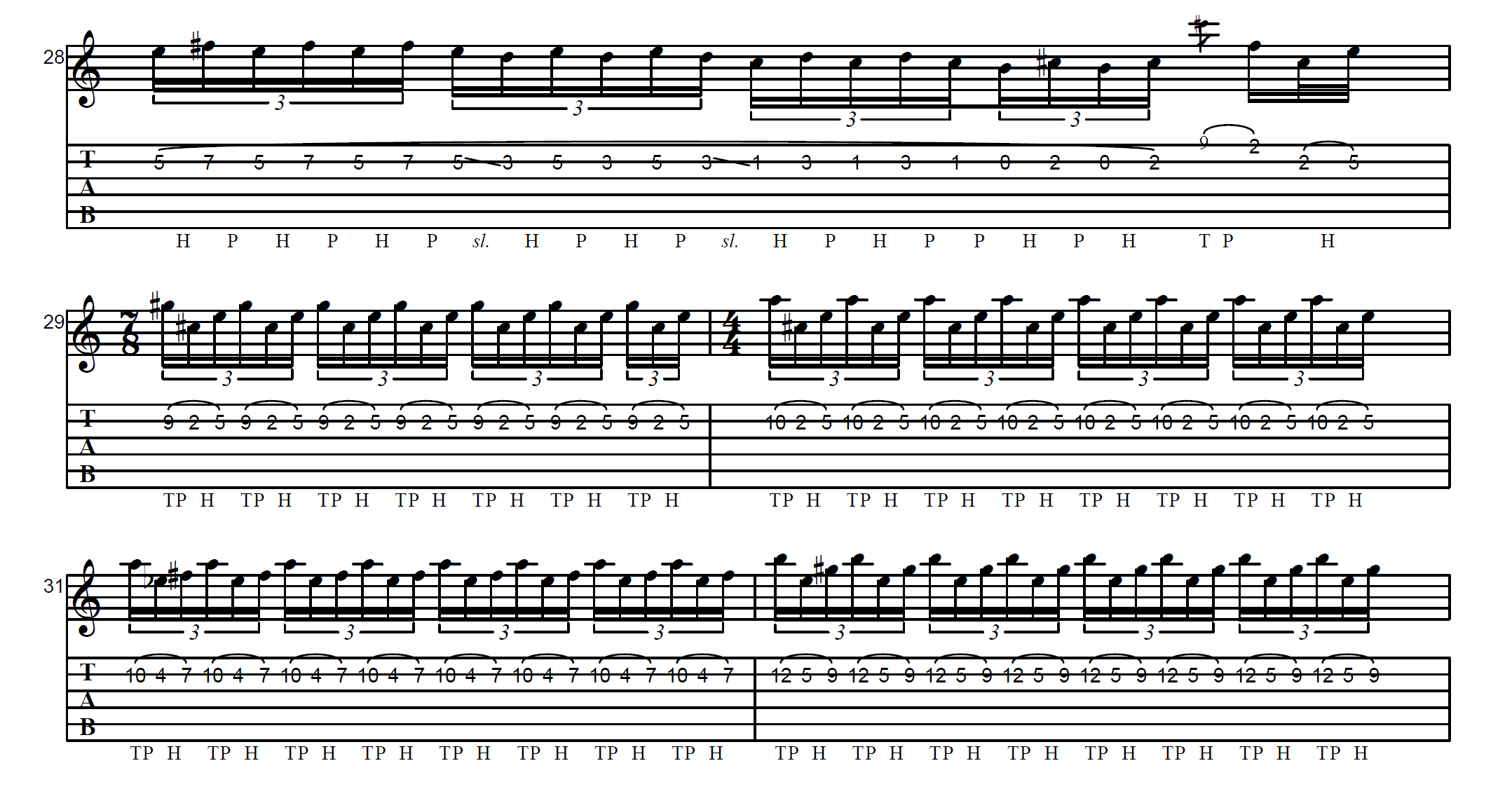
Even if you learn the code, you still have to play it. This is music code for the guitar. It is a piece of Eddie Van Halen’s “Eruption.” Guitar players, I wish you luck.
Alphabets ~
Alphabets are the easiest code variations to learn. Use the language code you already know but learn a new alphabet to represent it.
For Latin Script codes like English, you need to learn 26 glyphs to make words. You’ve already learned all of that as you’re proving right now. Unless you don’t understand what I’m writing. My dog, Vida, often reads over my shoulder, but she doesn’t understand the written form of English code. She just watches the letters appear, gets bored, and then leaves to go do something more fun. (I know she’s not alone on that matter so let’s wrap this up before you go too.)
Here are a couple of easy-to-learn sets of code glyphs. Variations of the Latin Script alphabet that I’ve used to compose this article in English language code.
The Phonetic Alphabet ~
You know, Alpha, Bravo, Charlie? There is more than one version of the Phonetic Alphabet, but here’s the one used in aviation and the military.
Alpha           November
Bravo           Oscar
Charlie         Papa
Delta           Quebec
Echo	        Romeo
Foxtrot	        Sierra
Golf	        Tango
Hotel	        Uniform
India	        Victor
Juliet	        Whiskey
Kilo	        X-ray
Lima	        Yankee
Mike	        Zulu
It’s fun. And you never know when it may come in handy one day. There are only 26 of them. I taught the Phonetic Alphabet to my kid while we drove to preschool. We practice by reading license plates out loud while we’re driving. Anybody can learn it in a week.
Here’s a set of code glyphs that are even more fun. Mentioned earlier.
Morse Code ~
Samuel Finley Breese Morse co-invented the telegraph, and then he invented a method of communicating with it: Morse Code.
You probably already know that it uses dots and dashes. Dots are short; Dashes are long. That’s it.
Each Latin Script letter is represented by a string of Morse Code glyphs. With this alphabet, you can communicate clearly by simply turning a light on and off, banging on a pipe, even tapping your finger gently on someone’s back. It works, as long as the receiver also knows Morse Code and the transmission is not just random dots and dashes. Because randomness does not convey a message.
A •–
B –•••
C –•–•
D –••
E •
F ••–•
G ––•
H ••••
I ••
J •–––
K –•–
L •–••
M ––

N –•
O –––
P •––•
Q ––•–
R •–•
S •••
T –
U ••–
V •••–
W •––
X –••–
Y –•––
Z ––••
Conclusion ~
Well. Does the logic hold up?
Randomness vs. Code.
Codes communicate; randomness does not.
–•–– ––– ••– •– •–• • •––• ––– •–•• –•–– –•–• ––– –•• •– •–•• –• ––– •––
I think it holds up good enough for a Friday. You’re a coder. Just thought I’d let you know that.
–•–– ––– ••– –•–• •–• •– ••–• – –•–– •–•• •• ••–• •.
Time to cook a pizza. Have a good weekend.
•– –• –•• ••• –•–• ––– •–• • –••• ––– •– •–• –•• ••• •–• • •– –•• • •–•
THE END_